Herman Roth and Alvin fight
The Plot Against AmericaHerman Roth and Alvin Roth’s fight breaks the fragile appearance of family reconciliation at a dinner welcoming Alvin home. In the shadow of political violence and Walter Winchell’s assassination, an argument over Alvin’s choices becomes a physical confrontation that leaves both men injured and the family shaken. Philip Roth recalls the scene as more than a private quarrel: it brings the country’s conflict into the living room and turns care, gratitude, and political conviction against one another.
A Homecoming Under Strain
Alvin arrives in a new Buick dressed in a pearl-gray sharkskin suit, with gifts for everyone. He brings Bess Roth a white apron decorated with red roses, Sandy Roth a sketchpad, Philip Roth a Phillies cap, and Herman Roth a certificate for a free lobster dinner in Atlantic City. The presents suggest that, despite having left for Philadelphia, Alvin remembers the warmth and generosity of the household that took him in. His wife, Minna Schapp, is already in the kitchen learning to make latkes with Bess Roth, while the family prepares a meal featuring Alvin’s favorite chocolate cake and latkes.
That welcome takes place in a city under siege. Bess Roth has to overcome her fear of going out to buy food, passing armed Newark police and glimpses of Bullet Apfelbaum’s Jewish police. The dinner therefore joins ordinary family care to a surrounding atmosphere of danger. For a time, the meal and the gifts make it seem possible that the family remains united. Philip Roth’s retrospective account makes that appearance precarious: the men whose affection and authority matter most to him are about to come into violent conflict.
The Argument and Its Stakes
The dispute grows from a divide between Herman Roth’s alarm at the danger confronting Jews and Alvin’s new hopes for himself. Herman sees Alvin’s flashy clothes, expensive car, and association with rough companions as signs that he has turned away from the persecution of Jews. He remembers Alvin’s earlier concern and cannot accept that his nephew now appears absorbed in his prospects while the political crisis grows more threatening. Beneath the rebuke is Herman’s sense of responsibility for the young man he had taken into his home and tried to guide.
Alvin answers from the position of someone who believes he has already paid dearly. He resents being judged by the relative whose guidance once mattered to him, and he connects the loss of his leg to having gone to fight for Jews and for Herman. His accusation makes clear that the two men understand Alvin’s military service differently: Herman treats it as evidence of political commitment, while Alvin invokes it as a sacrifice that has left him with a permanent disability and an uncertain future. The fight is thus not simply a disagreement over money, clothes, or conduct. It is a collision between Herman’s continuing moral demands and Alvin’s conviction that those demands have already cost him too much.
The Fight and Its Interruption
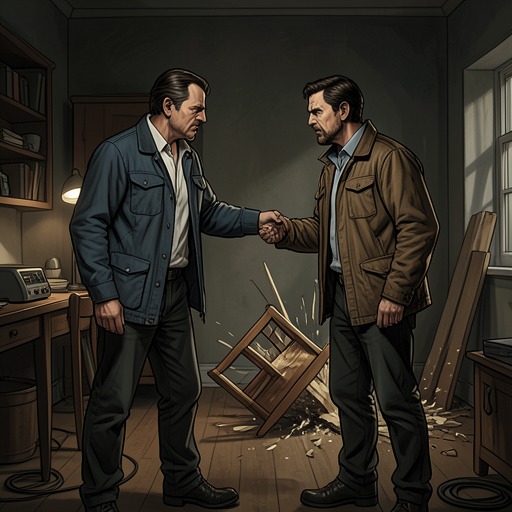
The argument erupts after the meal, as the men talk in the living room. Philip Roth had not imagined that Herman, whom he associated with restraint and abhorrence of street violence, could become physically destructive. In retrospect, he connects that shock to his father’s strength: Herman had once been a muscular young man, and had retained his broad shoulders and powerful build through years working as an insurance agent. The recollection changes the image of a father known for his moral authority into that of a man capable of sudden, uncontrolled force.
The fight overturns the room’s familiar domestic order. The coffee table is smashed, and the family’s cake and furnishings are caught up in the disorder. Mr. Cucuzza, the building’s night watchman, rushes in with a pistol after hearing the commotion. Minna Schapp becomes ill from the shock, and Philip Roth loses control of himself; Sandy Roth is the one who manages to call out that the intruder is Alvin. Mr. Cucuzza restrains Herman before the violence can continue. His intervention ends the immediate danger, but it does not restore the sense of safety the family had expected from the homecoming.
Both men suffer serious consequences. Alvin’s prosthesis breaks, and he sustains further injuries; Herman also requires treatment and wears a steel collar for months. The damage to the room and the injuries to the combatants make the scene’s reversal unmistakable: a dinner organized around welcome and familiar affection ends with the family confronting the consequences of a fight it could not contain.
Family Conflict and Political Violence
Philip Roth sets the fight beside the violence spreading beyond the household, including the riots in South Boston and Detroit, the assassination in Louisville, and the bombing in Cincinnati. He fears that the country’s anti-Semitism is being helped by Jews turning against one another. The living room, ordinarily a place where the family stands together against outside hostility, becomes a site of internal division. The connection does not make the family fight equivalent to the public violence; rather, it shows how political fear and social pressure can enter private relations and make them vulnerable to rupture.
The scene also complicates the meaning of Herman’s care. He had taken Alvin in and tried to reform and protect him, but Philip Roth recognizes that this intervention did not make Alvin into the person Herman hoped for. Alvin’s return brings back the household’s earlier generosity, yet his accusation shows that he experiences Herman’s guidance as entangled with the choice to fight and the loss that followed. Their opposing accounts of responsibility cannot be reconciled in the room. The fight leaves the family with the knowledge that affection and obligation have not prevented bitterness from taking hold.
Meaning of the Confrontation
The fight is a turning point in Philip Roth’s understanding of both men. Before it, Herman’s forcefulness seemed moral rather than physical, and Alvin’s return appeared to promise restored kinship. The confrontation reveals the anger beneath that promise and the capacity for violence within a family otherwise committed to keeping conflict under control. It also makes Alvin’s disability part of the argument’s lived stakes: his broken prosthesis and remembered sacrifice sharpen the conflict over who bears responsibility for his choices, without resolving it.
In the narrator’s later interpretation, Alvin’s decision to fight expresses a lasting contradiction: he sought to reject the values and obligations that shaped his life, yet acted out of a desire to remain faithful to them. That reading does not excuse the damage or settle the dispute between uncle and nephew. It gives the episode its tragic force: the same bonds that made Herman responsible for Alvin and made Alvin’s sacrifice meaningful also supplied the language of grievance through which the two men turned against each other.